
Elayn Hunt Release Routes
Elayn Hunt Correctional Center is a state correctional institution operated by Louisiana Department of Public Safety and Corrections, Corrections Services. Its releases are state-prison events. The Iberville Parish Sheriff’s Office does not control Hunt sentence computation, parole processing, transfer records, or final state discharge. A person transferred from Hunt to another DPS&C institution remains in state custody. Physical departure from the St. Gabriel grounds is not enough to prove freedom.
A release by diminution of sentence, often called good-time release, may lead to supervision when the law governing the sentence requires it. Parole also may lead to supervision through the Division of Probation and Parole. Full-term discharge can end physical custody without a P&P assignment. The exact legal result depends on the sentence, offense date, credits, exclusions, other commitments, and holds. Never translate a planned hearing or estimate into an actual gate release.
| State event | Meaning | Best confirmation |
|---|---|---|
| Projected release date | DPS&C computation if applicable | Locator and time computation |
| Parole grant | Committee action with possible conditions | Parole Decision Form |
| Institution transfer | State custody continues elsewhere | DPS&C location record |
| Actual discharge | Recorded end event under state authority | DPS&C discharge information |
Confirm Elayn Hunt Releases
The DPS&C offender-information page directs users to the imprisoned-person locator. Call 225-383-4580 with the DPS&C number, or the full name and date of birth. The automated system may provide current placement, facility address and telephone, an assigned P&P district, and a projected release date if one has been calculated. It is mainly a current authority and supervision tool, not a guaranteed permanent archive.
Follow the state record in order. Record the exact words returned rather than substituting “released.”
- Confirm the person with a DPS&C number or full identity and date of birth.
- Ask for the current facility, authority status, and projected release date if applicable.
- If parole is involved, obtain the official hearing action or Parole Decision Form. A grant alone does not prove physical release.
- Check the assigned P&P district only when community supervision is shown.
- For a past release no longer visible, request the actual admission and discharge facts from DPS&C public records.
Elayn Hunt Records Contact
The official facility page supplies the institution address and general telephone. Facility staff can confirm the right office or current operational contact, but the prison contact page is not a release database. Central DPS&C channels control sentence computation and historical public-record requests. Keep routine facility contact separate from a request for the master record’s releasable discharge facts.
Elayn Hunt Correctional Center
6925 Highway 74
St. Gabriel, LA 70776
Telephone: 225-642-3306
Hours: Confirm through the official facility page
For a written historical request, send a narrow request to Louisiana DPS&C, attention Deputy Secretary’s Office, P.O. Box 94304, Baton Rouge, LA 70804. The public-information channel lists 225-342-6744, fax 225-342-3095, and docpublicrecords@la.gov. Include the DPS&C number, name, court case, approximate dates, institution, release basis, actual discharge date, and supervision assignment. Use 225-342-0799 for sentence-calculation questions instead.
Louisiana R.S. 15:574.12 makes much prison and preparole material confidential, but subsection G identifies general information available on request, including age, offense, conviction date, sentence length, and discharge date. Request only the public facts needed. Medical, victim, security, juvenile, and other protected material may be withheld or redacted.
When community supervision follows release, the assigned office may not be in St. Gabriel. DPS&C identifies West Baton Rouge District as serving Iberville, at 1120 Northwest Drive, Port Allen, with telephone 225-342-2770 and listed weekday hours of 8:00 a.m. to 4:30 p.m. The automated locator may identify the actual assigned district. Use that result rather than selecting an office from the release institution’s address. The supervising district, sentencing parish, and institution can be three different places.
The Louisiana Board of Pardons and Committee on Parole keeps a separate record. Its public dockets show scheduled matters, while the Parole Decision Form records the official action. A grant may lead to preparation of a parole certificate and may include conditions. A conditional grant can require specified programming. Neither a docket nor a favorable decision establishes that Hunt completed the physical release. Check the later DPS&C custody or P&P record.
Elayn Hunt Release Preparation
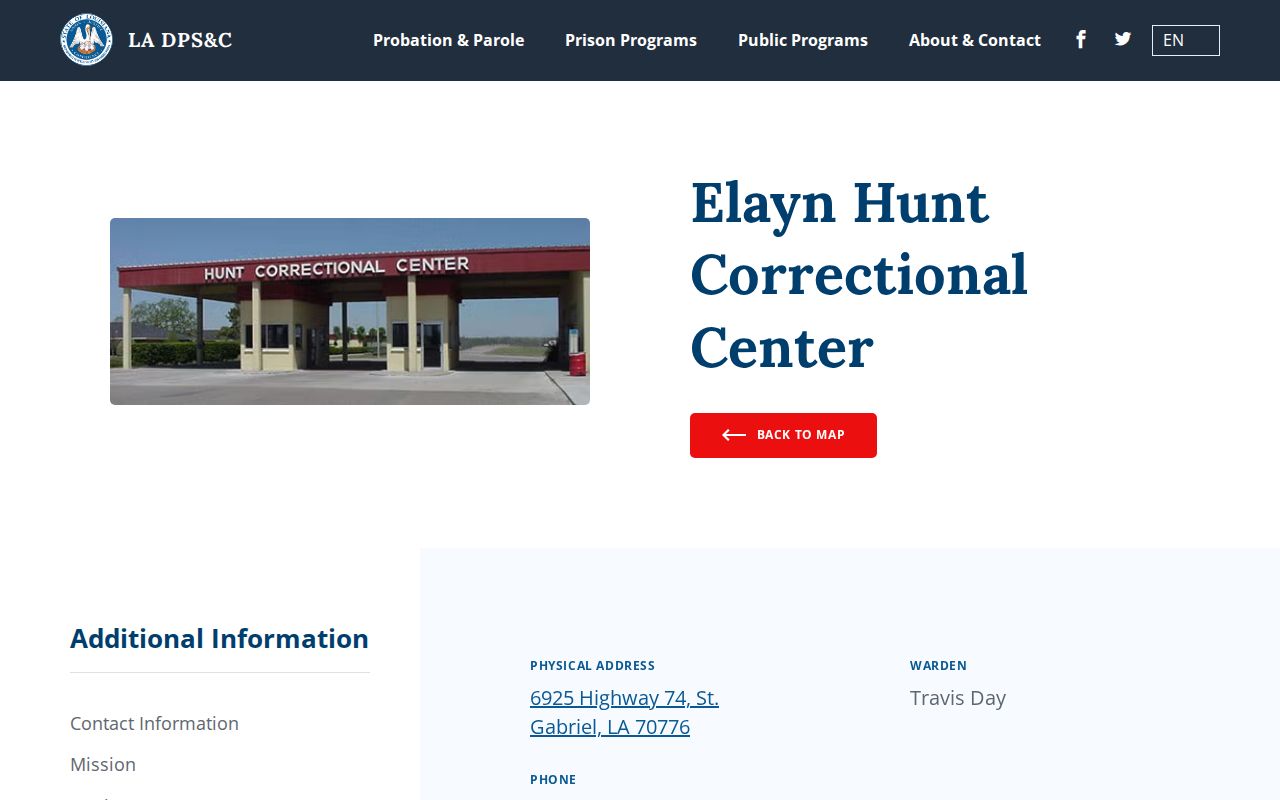
The official Elayn Hunt facility page is the source for current institution details and its descriptions of educational and reentry initiatives.
The official page documents preparation for release, but a program description does not prove that one person completed a course, received parole, or left custody. Program participation and release status are different records. Ask DPS&C for the actual event tied to the person’s number.
Release preparation can begin while a person remains imprisoned. It may include educational work and other reentry planning. Eligibility, completion, placement, transportation, property return, and the final departure process cannot be inferred from a general program page. No verified public gate schedule, family waiting area, transit plan, or weekend-release procedure for Hunt was established in the research.
Elayn Hunt Release Date Limits
DPS&C uses the term “projected release date.” That wording matters. The date may be blank until official sentencing paperwork arrives and time computation is complete. It can later change because of amended judgments, prior-custody credit, concurrent or consecutive sentences, good-time forfeiture or restoration, parole action, a detainer, another sentence, or a correction.
Louisiana’s rules changed for offenses committed on or after August 1, 2024. R.S. 15:571.3.1 generally permits eligible felony prisoners to earn good time up to a maximum of 15 percent of the imposed sentence, subject to stated exclusions and other rules. That does not create one safe “serve 85 percent” calculation for all people. Earlier offenses fall under detailed branches of R.S. 15:571.3, and parole rules also depend on offense date and category.
A detainer can also block physical release after one sentence calculation reaches its expected end. Ask whether another Louisiana case, another jurisdiction, or a federal authority has an active hold. If Hunt records a transfer, obtain the receiving agency’s name and continue the search there. The correct result may be that one sentence ended while custody continued for a separate legal reason. Keeping those events apart prevents a projected state date from being mistaken for a community return.
- Projected date
- A computed estimate supplied if applicable.
- Parole eligibility
- A possible consideration point, not release.
- Conditional grant
- A parole decision that requires stated conditions before release.
- Discharge date
- The recorded historical date the relevant state authority ended.
For a focused explanation of the computation sources, consult the Iberville Parish inmate release date page. Individual calculations still belong to DPS&C and the applicable court record.
Offense date is essential. R.S. 15:574.22 largely ended parole eligibility for offenses committed on or after August 1, 2024, while retaining enumerated special classes. Earlier offenses use the category-specific framework in R.S. 15:574.4. Those earlier provisions contain different thresholds and exclusions for violent, nonviolent, sex-offense, repeat, age-based, medical, and other categories. A percentage can identify only a possible consideration point after all conditions are known. It cannot prove a Hunt release.
Elayn Hunt Geography Trap
Elayn Hunt and Louisiana Correctional Institute for Women occupy adjacent Highway 74 addresses in St. Gabriel. Both are in Iberville Parish, and both are state institutions. This unusual local geography makes the operator more important than the parish name. A person at Hunt may never have an IPSO booking connected to the state term.
The DPS&C facility directory should control current location and contact information. Archived news can lag operational change. Likewise, the nearby LCIW record must not be substituted for a Hunt record merely because the addresses are close. Confirm the exact institution, DPS&C number, and legal authority.
A state-sentenced person may also be housed temporarily in a parish jail while awaiting placement. Search by authority, not by the nearest building. The same rule works after departure: DPS&C documents a Hunt discharge, P&P documents state supervision, and the court explains the sentence.
Louisiana notification sources add useful timing but not certified history. VINELink or LAVNS may report a custody or supervision event from a participating agency. DPS&C Victim Services operates a separate registration process for qualifying notice recipients. A reported event should be checked against the source agency and its update time. For a historical Hunt release, the discharge information requested from DPS&C remains the stronger record. No result may reflect a delay, spelling issue, excluded data, or completed discharge, so it cannot close the search alone.
Note: St. Gabriel geography cannot establish which institution held a person or whether an actual release occurred.